- Lunch With Norm
- Posts
- [LWN] 🤦♂️ I Can’t Explain This...
[LWN] 🤦♂️ I Can’t Explain This...
Lunch With Norm's Weekly Newsletter - Amazon News & Updates
🤦♂️ I Can’t Explain This…

What you’ll find in this week’s newsletter:
🤦♂️ I Can’t Explain This... [True Story]
📊 Amazon Seller Registrations Hit Decade Low
💊 Amazon Sets Deadline on Inflated Supplement Ingredient Claims
⚒️ How to Create a 3-tab AI App! [Step-By-Step Guide]
🔥 Secret AI Shortcuts Your Competitors Use Daily...
Hey Beardos, I’ve got a quick message today.

I am speaking at BDSS 13 Virtual (Jan 20-22)! There’s still time to pick up last minute tickets. It’s packed with the very best in the industry.
See you there.
🤦♂️ I Can’t Explain This… [TRUE STORY]
This story goes back to the 80s, when I was in college studying film and cinematography.
For one of our midterms, we had to produce a short film, and part of our shoot was planned at Yorkdale Mall in Toronto.
Five of us piled into a tiny car with cameras and gear, joking around like broke college kids do.
On the way, my buddy suddenly slammed on the brakes.

Sitting on the side of the road was an architect’s tube, one of those long cardboard cylinders with caps on both ends.
For reasons I still can’t explain, he got out, picked it up, and tossed it into the car.

This is what we picked up on the side of the road.
There was a name written on the cap, but none of us thought much of it. We just kept going.
We arrived at the mall, started setting up our shots, and as we were getting ready to roll, this tiny elderly woman walked over and struck up a conversation.
She asked what we were doing, and I told her we were shooting our midterm for college.
She smiled and said her granddaughter went to the same school.
Then she paused and added that her daughter had just told her something awful. Her granddaughter had lost her midterm. All of it. Her architecture drawings.
Gone.
When she said her granddaughter’s name, every one of us froze.
We slowly looked at each other, then at the tube sitting near our gear.
I picked it up, checked the name on the cap, and said, “I think this belongs to your granddaughter.”
Inside were her missing midterm drawings.
The grandmother couldn’t believe it.
We couldn’t believe it.

Out of all the places, all the people, all the timing, that tube ended up in our car.
By the end of the day, her granddaughter had her midterms back, and five film students were left speechless.
Business lesson:
Opportunities, connections, and solutions don’t always show up through strategy or planning.
Sometimes they come from paying attention, being honest, and doing the right thing when chance puts something in your hands.
In business, those moments matter.
You never know when a random stop on the road turns into a defining moment.
— Norm

👇AMAZON NEWS AND UPDATES👇
🚀 Walmart expands AI-powered shopping with Google Gemini
💡 Amazon takes on Walmart with new store concept
🔍 Track Amazon Business customer patterns with new metrics
🚨 Amazon acquires Rightbot, adds to Robotics Delivery and Packaging Innovation team
🌎 Amazon holds talks with suppliers on pricing following tariff changes
✅ 4 TikTok Shop payment policies every seller should know
🚨 Amazon Seller Registrations Hit Decade Low in 2025
Back when I first got into this game, Amazon was the wild west.
Some stuck with it. Some didn’t. But the barrier to entry was low, and the upside was massive.
That era is over.
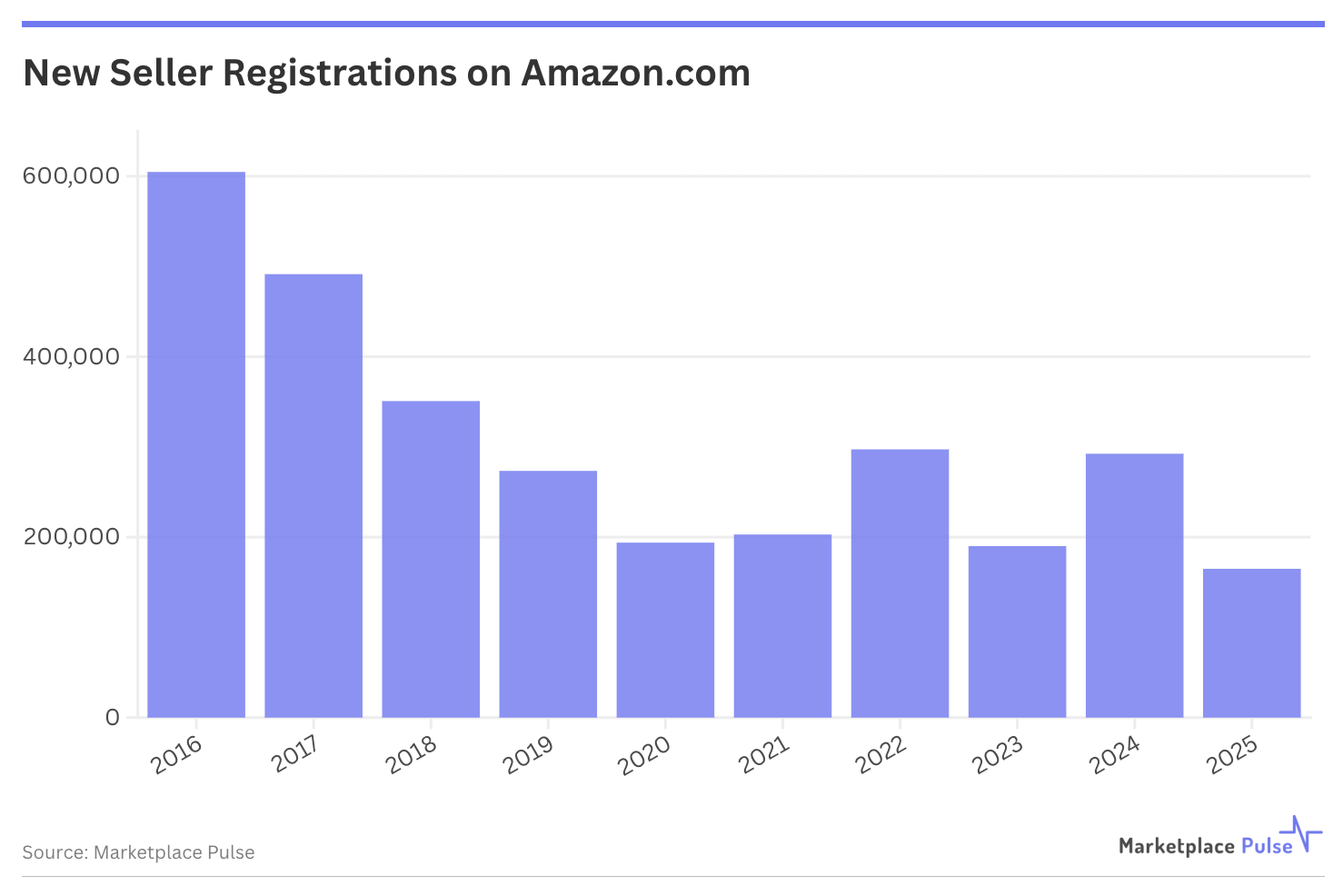
In 2025, Amazon recorded just 165,000 new seller registrations.
That’s the lowest number in a decade, down 44% from last year. And it’s not because e-commerce is shrinking. Amazon’s third-party GMV hit $575 billion globally.
What we’re seeing now is what I’d call a “professionalization moment.” The hobbyists, the “easy money” seekers, they’re being squeezed out.
Tariffs, AI competition, rising ad costs, platform fees, and increasing pressure from overseas sellers (especially China) have pushed out casual players.
Over 100,000 sellers now do over $1 million a year. 235 sellers do $100 million or more.
And for those willing to adapt, the opportunity has expanded. There are fewer new sellers, fewer active sellers overall—but traffic per seller is up 31% since 2021.
What does this mean if you're just getting in?
It’s no longer about “trying Amazon.” It’s about building on Amazon.
You’ll need capital. You’ll need systems. You’ll need a clear brand story.
And most importantly, you’ll need patience.
The biggest winners today?
Sellers who got in early and built for the long haul. More than 60% of the top 10,000 sellers joined before 2019.
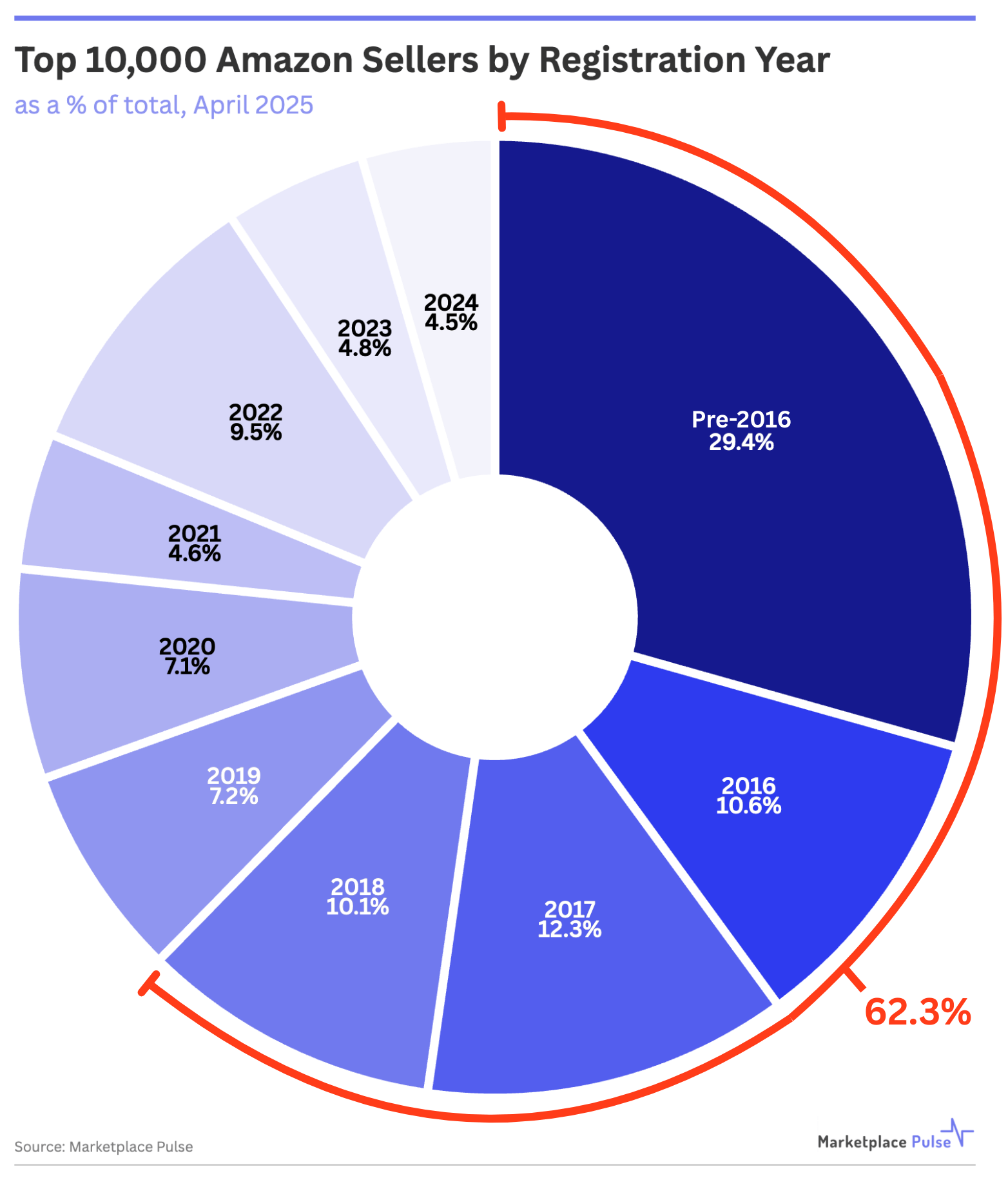
But that doesn’t mean the door is closed. It just means the rules have changed.
💊 Amazon Sets Deadline on Inflated Supplement Ingredient Claims
Amazon has notified dietary supplement sellers that starting March 31, 2026, listings with misleading or inflated ingredient claims risk deactivation.

The focus is simple: what you say on your listing must match your Supplement Facts Panel exactly. Amazon is no longer treating supplement listings like marketing pages. They’re treating them like regulated labels.
For years, sellers got away with creative storytelling. That window is closing.
What Amazon is actually targeting
The main issue Amazon is cracking down on is inflated ingredient weights, especially in herbal supplements. A common example is listing a product as “10,000mg herb equivalent” when the Supplement Facts Panel only shows 500mg of extract.
Even if that conversion is technically true in sourcing terms, it’s now considered misleading unless the conversion is clearly documented on the label itself.
In short, if the weight isn’t printed on the Supplement Facts Panel, it doesn’t belong anywhere on the product detail page. That includes titles, bullets, descriptions, A+ Content, and images.
Legitimate scientific conversions are still allowed. For example, presenting Vitamin D as both IU and micrograms is fine, as long as both values appear on the panel. What Amazon no longer allows is turning extract weights into larger raw-material numbers for marketing impact.
The Timeline
May 16, 2025
Amazon rolls out AI that scans brand websites for policy violations, extending enforcement beyond the marketplace.August 18, 2025
Many sellers report sales drops of 60–80% year over year as platform changes and economic pressure stack up.August 26, 2025
Amazon pauses its variation theme cleanup after seller backlash, later narrowing removals to deprecated themes with no sales history.October 11, 2025
Amazon launches the Seller Challenge feature, giving eligible sellers another layer of appeal for listing-level enforcement actions.January 3, 2025
Amazon announces a 200-character product title limit, taking effect January 21, 2025.January 7, 2026
Amazon outlines new rules to stop review sharing between functionally different variations, effective February 12, 2026.January 14, 2026
Amazon’s Regulatory Intelligence, Safety and Compliance team alerts supplement sellers to upcoming enforcement on misleading ingredient weight claims.March 31, 2026
Deadline for supplement listings to comply with ingredient composition rules before Amazon begins deactivations.
Why this is different from past policy updates
Amazon’s Regulatory Intelligence, Safety and Compliance team has made it clear that supplements are now being evaluated as regulated products, not as brand storytelling opportunities.
Amazon is also using AI systems to cross-check listing copy against product images, Supplement Facts Panels, and even claims made on external brand websites.
That means old copy that’s been sitting untouched for years is suddenly risky. Most sellers won’t be deactivated because their products are unsafe. They’ll be deactivated because the listing copy no longer aligns with the label.
What sellers need to understand before March 31
Amazon expects every dietary supplement listing to present ingredient names, weights, and serving sizes consistently and accurately.
Product images must clearly show the full label, including the Supplement Facts Panel, ingredients list, brand information, and identifying codes like lot numbers.
This applies to everyone. Seller Central, Vendor Central, private label brands, manufacturers, and resellers are all held to the same standard.
If you’re reselling someone else’s brand, you’re still responsible for making sure the listing matches the label exactly.
The bigger challenge is scale.
Sellers with large catalogs now have to audit hundreds or thousands of ASINs and clean up legacy copy that was never reviewed through a compliance lens.
Amazon’s systems can now flag discrepancies automatically, so waiting this out is not a viable strategy.
🌎 Where in the World is The Beard Guy?

Can you find Norm in the picture below? Scroll to the bottom of this newsletter to see the answer!
⚒️ How to Create a 3-ta[b AI App!
Level: Easy
How We Did It
Here’s the exact build we followed to create a simple AI app with three tabs, then secure it properly so the API key never shows up in the front-end. If you can type prompts and click buttons, you can do this.
1. Draft the front-end in Lovable
Start in Lovable and write a single prompt describing the app you want: a simple menu with three pages or tabs for a chatbot, a text-to-image generator, and a vision model that can describe uploaded images.

In a couple minutes, you’ll get a first version that looks real, but it won’t be “powered” yet. That’s fine. This step is about layout, navigation, and flow, not model wiring.
2. Create one API key in Nebius AI Studio
Open Nebius AI Studio and generate an API key for this project. Name it something obvious like “AI Playground” so you can track it later. Treat that key like a password.
If it ends up in your front-end code, anyone can copy it and run usage on your account. The whole build depends on keeping that key on the backend, not in the browser.

3. Add a backend in Lovable using Supabase
In Lovable, connect Supabase to create a backend project. You don’t need to understand the technical screens. The only thing that matters is this: the backend is where secrets live.
Once Supabase is connected, use Lovable’s chat mode to tell it you’ve connected Supabase and you want to store the AI Studio API key securely in the backend, then wire each feature (chat, images, vision) to the right model.
4. Let Lovable generate the wiring plan, then implement it
Ask Lovable to create a plan for connecting the chatbot, image generator, and vision analyzer to Nebius AI Studio using the API key stored in Supabase. You’ll see a detailed checklist. Then tell it to implement the plan.
After a couple minutes, you should have a working app: chat replies show up, images generate, and the vision model describes what’s in an uploaded image.
This is the moment you go from “mock app” to “real app.”

5. Add a Setup page for system prompt + model switching
Now fix the “polish” issues that make an app feel incomplete. Create a Setup page where you can set a system prompt (hidden instructions that control how the chatbot responds) and pick models without editing code.
For example, you can set a system prompt that forces plain text responses and consistent formatting. Add a model picker so you can swap models by pasting a model name from AI Studio. Save settings so changes apply instantly.
This turns your app into a reusable playground instead of a one-off demo.
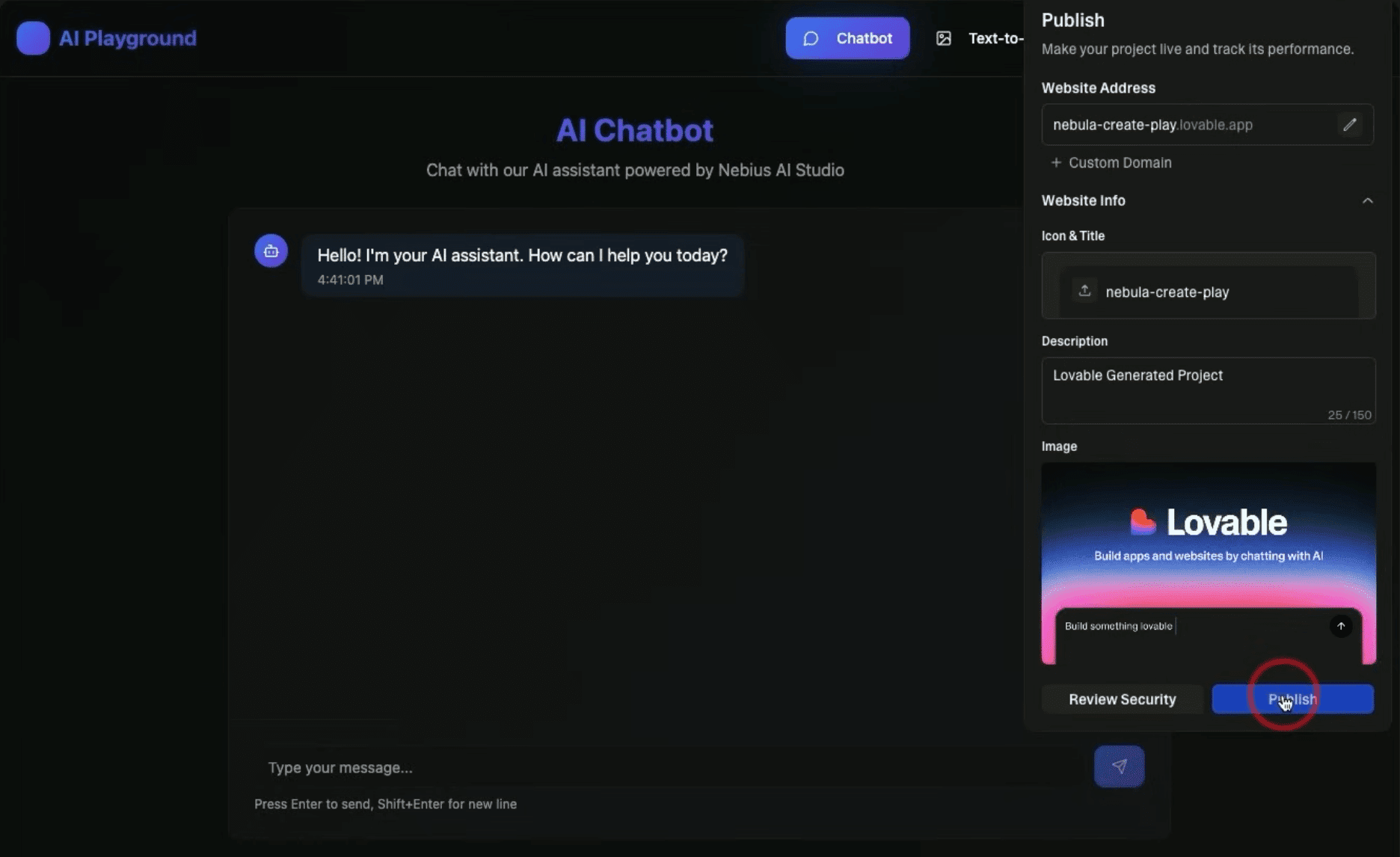
6. Add small UX wins, then publish with a security check
Ask Lovable to add a “New Chat” button so users can reset conversations without refreshing the page. Add a one-click light mode toggle so people can choose a theme. Then use the “Review security” option before publishing. Fix any issues it flags, then publish to generate a shareable link
If you want it to look like a real product, connect a custom domain after it’s stable.
Bonus Pro Tip
Lock down the Setup page: If you add system prompts and model switching, consider making that page admin-only. You can keep it hidden, or add login so users don’t change settings. It keeps your app consistent and prevents support headaches.
If you would like to learn more about AI check out FUTUREPEDIA

🔥 Secret AI Shortcuts Your Competitors Use Daily...

Here are my favorite tips from this episode!
1. Speed becomes a competitive advantage when process is documented
Rachel’s influencer vetting case proves that the bottleneck was never “finding better tools,” it was the existence of a clear, documented process. Once the SOP existed, AI collapsed a three-week timeline into hours. Sellers should understand that documenting workflows is not busywork. It directly converts into faster launches, faster testing, and faster revenue once AI is layered on top.
2. AI amplifies good processes and exposes bad ones
The episode makes it clear that AI does not fix broken operations. It scales whatever already exists. The reason the influencer workflow worked so well with AI is because it was already precise and detailed. Sellers should audit their workflows before adding AI. If the process is vague, inconsistent, or dependent on tribal knowledge, AI will simply produce average or unreliable results.
3. Downsizing with AI is short-term thinking
A critical takeaway is that treating AI as a replacement strategy instead of a leverage strategy creates long-term fragility. The businesses getting the most value are keeping humans focused on innovation and decision-making while AI handles execution. Sellers who remove all human oversight lose the ability to improve offers, creatives, and strategy over time.
4. “Own the playbook, rent the tech” is the real moat
Tools will change, models will improve, and platforms will wipe out point solutions overnight. What survives is the internal playbook. Sellers who invest in documenting how they do research, sourcing, launches, ads, and compliance can swap AI tools without starting over. This protects the business from tool churn and vendor risk.
5. Custom GPTs are the fastest entry point for solo sellers
For sellers without teams, the most actionable move is converting repeat tasks into custom GPTs. Brain-dump the steps, refine them once, and reuse them indefinitely. This turns AI into a reusable asset rather than a one-off assistant and compounds time savings across listing creation, keyword research, supplier outreach, and compliance checks.
🔥 Watch the full episode here
Find this episode of Marketing Misfits on YouTube and anywhere you listen to podcasts
🌎 MARK DOWN THESE EVENTS! 🌎
Jan 20-22 - Virtual - Starting at $497
Feb 10-12 - Dubai - Free
Feb 23-26 - Palm Springs - $499.50
Mar 9-11 - Las Vegas - $895 (For Non Members)
Mar 10-12 - Las Vegas - Starting at $99
April 8 - 12 - Nashville - Starting at $497
April 21 - 23 - Fort Lauderdale - $799
→ FULL CALENDAR ←
And that’s it, Beardos.
See you next Monday!
- Norm

Interested in sponsoring the Lunch With Norm Newsletter? Reply back to this email for more details.
Reply