- Lunch With Norm
- Posts
- [LWN] 🤦♂️ I Got Caught Lying...
[LWN] 🤦♂️ I Got Caught Lying...
Lunch With Norm's Weekly Newsletter - Amazon News & Updates
🤦♂️ I Got Caught Lying...

What you’ll find in this week’s newsletter:
🤦♂️ I Got Caught Lying… [True Story]
💰 The 1% of Amazon Sellers
🦞 Everything You Need to Know About Moltbolt
⚒️ Turn Your FAQ Doc Into Your Own Assistant [How to Guide]
🔥 How a Joke Turned Into a Cigar Empire
🤦♂️ I Got Caught Lying… [TRUE STORY]
Back in 1977, my dad and uncle owned a campground right near the Quebec and U.S. border.
It was the kind of place where you met people you’d never forget.
And that’s where I met George.
George and his family stayed all summer at the campground.
He was 17, from Point Charles in Montreal. Back then, it was a pretty tough neighborhood.
He was loyal, funny, and overall a solid guy but he definitely had an edge to him.
We clicked right away and became close friends.
One day, George showed up with a brand-new motorcycle.
He was extremely proud of his bike.
One afternoon he said, “Hey, did you want to take it for a spin?”
I said “No”.
I had never rode a motorcycle before.
He insisted, and I said “No” again.
Then “No” a third time.
Eventually, he wore me down.
How hard could it be?
So I hopped on, fired it up, and took off down the road.

Here’s the problem.
Nobody told me motorcycles had gears…
I rode that thing for a couple of miles, engine screaming, thinking I was doing great.
I felt like I was flying.
Then the bike stalled.
I stood there staring at it in disbelief.
I was stuck in the middle of nowhere so I did the only thing I could do, I pushed it.
By the time I got it back, I was exhausted.
I handed the bike to George and said, “I don’t know what happened but I think the engine seized.”
He couldn’t believe it.
A week later, he came back after taking it to a mechanic.
He asked me one question.
“Did you change gears?”
I instantly said, “Oh yeah, of course.”
I was too scared to admit I didn’t know how to ride a motorcycle.
I didn’t even know they had gears.
Apparently, the oil had overheated so badly that it basically turned into glue.
I destroyed something my friend worked so hard for.
So I came clean.

I told George the truth and we made an agreement that I would pay for the repair.
Over the next few months, every dollar I made went to paying off that bike.
My dad had no idea that my entire summer’s pay went towards fixing my mistake.
But I was able to sleep at night because I knew it was the right thing to do.
Business Lesson
Own your mistakes.
Things will inevitably break in business. What matters most is how you handle it.
You can make excuses, you can shift blame or you can take responsibility and pay the price of your mistake.
Trust is built when you step up, even when nobody is watching.
— Norm

👇AMAZON NEWS AND UPDATES👇
🤖 How AI conversations are replacing traditional search results for retail
🚀 Lowe’s tests AI voice agents to handle customer calls across all stores
🚢 2026 Supply Chain Trends: Problem solving labor shortages, robotics, and warehouse constraints
🔥 Amazon's seller pricing limits face Canadian review
💰 Amazon Deemed Seller VAT fraud reform would raise tax revenues and tackle fraud
🛒 Walmart earnings, spending data, and more AI disruptions: What to watch this week
🔍 OpenClaw creator Peter Steinberger joins OpenAI
💰 The Top 1% of Sellers Now Drive 50% of Amazon’s 3P GMV
This is one of the most important Amazon data points I’ve seen in a while, because it confirms what top operators have been feeling for the last two years:
Amazon is becoming a power-law marketplace where a large portion of sales on a marketplace is generated by a small fraction of its sellers population.

Fewer than 8,000 sellers now generate 50% of Amazon’s U.S. third-party GMV.
That’s roughly $150B of the estimated $300B in U.S. third-party GMV. And those 8,000 sellers represent only 1.6% of the active U.S. seller base.
In 2023, it took about 15,000 sellers to generate that same 50%.
That means Amazon’s revenue concentration at the top has nearly doubled in less than three years.

Amazon has also gotten more expensive to operate.
Between:
rising FBA fees
advertising inflation
margin pressure
tariffs
higher customer expectations
and stricter performance metrics
Amazon rewards more than ever sellers that have operational sophistication and capital reserves.
The Concentration Is Extreme at Every Level
The distribution is sharp across all tiers:
111 sellers generate 10% of 3P GMV
1,020 sellers generate 25%
7,760 sellers generate 50%
And the active U.S. seller base is estimated around 500,000 sellers (defined as receiving at least one seller feedback in the past year).
Even though the number of sellers in the “top 50% GMV” cohort dropped from 15,000 to 7,760, the GMV they represent grew from about $115B to $150B.
So the pie got bigger, and fewer sellers captured it. This has pushed average revenue per seller in this cohort to nearly $20M annually, more than doubling.
Another detail that matters: U.S. sellers dominate the top end economically.
U.S. sellers represent 55% of the top cohort
but control 67% of their combined GMV
Chinese sellers represent 41% of the cohort, but generate 30% of the GMV.
So yes, China is heavily present but the biggest revenue density is still coming from U.S.-based operators.
The $5M+ Tier Is Now the Real Threshold
Every seller in this 7,760 group is doing at least $5M per year, and there are around 9,000 sellers total in the $5M+ tier.
That tells me something simple: $5M/year has become the minimum scale where Amazon becomes truly defensible.
The sellers who win in 2026 will not be the ones with the most products.
They will be the ones with the best systems.
Because Amazon is no longer a platform where you “get lucky” and stay lucky.
It’s a platform where the top 1.6% are building machines, and everyone else is competing against the machine.
🦞 Everything You Need to Know About the Viral Personal AI Assistant

Moltbot is the latest AI agent to go viral, and it has a very simple pitch:
It’s an AI assistant that actually takes actions
Moltbot was launched as a scrappy project built by one developer, Austrian founder Peter Steinberger (@steipete).
What Makes Moltbot Different?
Self-hosted: Runs on your own hardware (Mac, Linux, Windows via WSL2, Raspberry Pi)
Multi-channel: Connects to 10+ messaging platforms simultaneously
Extensible: Plugin-based architecture with a growing skills marketplace (ClawdHub)
Proactive: Can reach out to you with reminders, updates, and insights
Agent-capable: Supports multi-agent orchestration and autonomous task execution
It originally went by Clawdbot, a lobster-themed name inspired by Anthropic’s Claude, but it was forced to rebrand after a legal challenge. The new name is Moltbot, and the lobster theme stayed.

Moltbot can do real tasks like:
manage your calendar
send messages through apps
check you in for flights
automate workflows across your computer
It racked up over 44,200+ GitHub stars in a very short time. Cloudflare’s stock also jumped 14% premarket after social buzz tied Moltbot’s rise to Cloudflare infrastructure used to run it locally.
But it does come with a risk, and it’s called prompt injection through content.
In plain terms, someone can send you a message on WhatsApp or another app that tricks the agent into taking actions you didn’t intend, without you noticing in time.
Moltbot is open source, which helps. It can run locally instead of in the cloud, which also helps. But neither of those removes the core issue:
Autonomy + Permissions = Exposure.
The safest way to run Moltbot today is in a silo:
a separate machine or VPS
throwaway accounts
no access to your password manager, API keys, or sensitive files
That setup defeats the whole point of a personal assistant, which is why this is still early adopter territory.
Moltbot is a real glimpse of where AI agents are headed.
🌎 Where in the World is The Beard Guy?

Can you find Norm in the picture below? Scroll to the bottom of this newsletter to see the answer!
⚒️ Turn Your FAQ Doc Into a Consistent Response Assistant
Level: Medium
How We Did It
Here’s the setup we used, plus a few tweaks that make it safer and easier to reuse across a team.
1. Open Gems & start from “New Gem”
Inside of Google Gemini, open the left panel and click Gems, then choose New Gem. This puts you in a simple builder where the Gem’s behavior is controlled by one instruction block, not a fresh prompt every time.

2. Name the Gem like a job title, not a feature
Use a name that tells your team exactly when to use it, like “Customer Support Drafter” or “Lead Follow-Up Qualifier.”
Clear naming matters because Gems add up quickly, and the whole point is fast reuse without thinking.

3. Write instructions like you’re training a new hire
In the instruction box, describe the task, the rules, and the output format. Keep it tight and specific.
For example: tone rules, what to ask first, what to avoid, and what a “good” answer looks like.
Add constraints that reduce mistakes, like “If a request is unclear, ask one follow-up question” or “If the info is missing, state what you need before drafting.”

4. Add a small knowledge base for answers you repeat
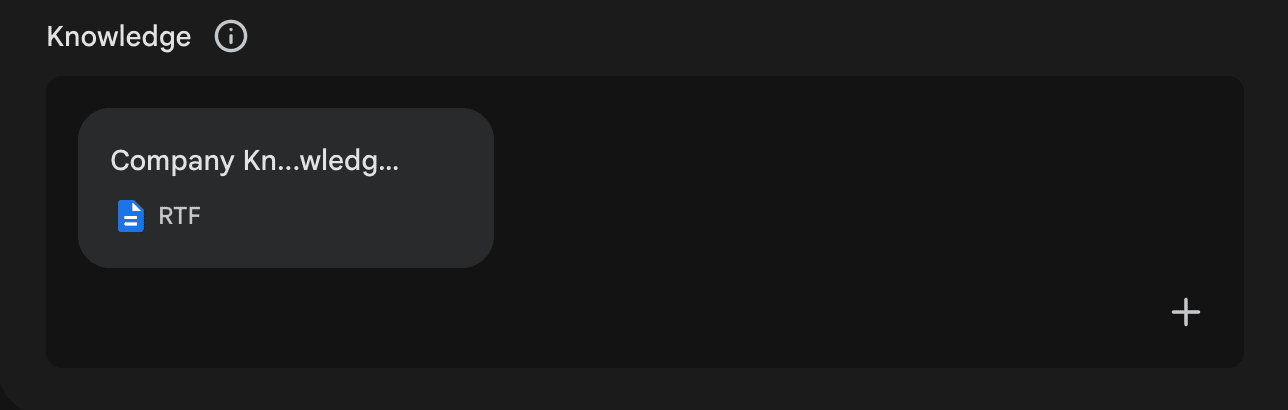
Click the plus icon in the knowledge base area and upload your most-used references (up to 10 files). Good candidates: FAQs, brand voice guidelines, policy snippets, and approved templates.
This keeps the Gem grounded in your actual docs instead of guessing. It also helps teammates respond consistently without hunting through folders.
5. Save, pin, and use it with minimal input
Save the Gem, then pin it so it stays in the left sidebar. When a new request comes in, paste only what the Gem needs (the customer message, form submission, or lead details). Because the rules already live in the Gem, you can skip the long setup prompt and get straight to a draft.

6. Refine after real use, not before
After a few runs, edit the Gem and tighten the parts that caused weak outputs. Add one rule at a time, like “Offer two reply options” or “Include a 1-sentence summary up top.”
This is how the Gem becomes a reliable internal assistant instead of a one-off experiment.
If you would like to learn more about AI check out FUTUREPEDIA

🔥 How a Joke Turned Into a Cigar Empire...

Here are my favorite tips from this episode!
1) “Broker model” is the cleanest analogy for modern agencies and fractional operators
The cigar industry has 3 go-to-market models: pull-only brand, in-house reps, or broker (shared reps). Sellers should steal this framework for their own business decisions: when you’re too small to hire full-time specialists (creative, CRO, email, influencer, PR, SEO), you don’t need to “do it yourself.” You need a shared expert model (fractional, retainer, or performance-based) until the unit economics justify in-house. This is the clearest way to avoid premature hiring and avoid being trapped in freelancer chaos.
2) The real interview question is “Do you work yourself out of a job?”
Brandon’s million-dollar question is basically: “When we hit scale, are you going to replace me?” Sellers should apply this to every partner: agencies, influencers, distributors, even employees. The most dangerous partnerships are the ones where the other party’s incentive is to extract value until you’re strong enough to replace them. Advanced sellers structure deals so growth creates shared upside, not a trigger for renegotiation.
3) Commission-based relationships only work when trust is enforceable
This episode makes something very clear: in a commission model, the biggest risk is getting paid. Sellers should translate this directly into influencer/affiliate programs, agency rev-share, or wholesale reps. If you cannot enforce reporting, payout timelines, and auditability, the relationship becomes a cashflow liability. The advanced move is to treat commission models like finance: tight terms, clear triggers, and zero ambiguity.
4) Brand story beats product features, but only if the product clears a minimum quality bar
Once quality is acceptable, story becomes the differentiator. That is exactly how DTC brands win today. If your product is “good enough,” the advantage comes from: identity, association, community, and who the buyer feels they’re supporting. Sellers should stop over-investing in feature differences that customers don’t notice and start investing in story, credibility, and emotional association.
5) Loss leaders only work if you know what the “real profit center” is
Cigar lounges are a loss leader. The profit comes from customers who buy and leave, and from alcohol if available. Sellers should apply this to: low-margin entry SKUs, first-purchase discounts, bundles, and TikTok Shop affiliate seeding. The advanced insight is: loss leaders are not “cheap products.” They’re deliberate customer acquisition mechanisms that must connect to a higher-margin repeat purchase path.
6) The “third reorder rule” is how you should think about CAC payback
Brandon says he doesn’t really make money until the third reorder, because the relationship cost must be recovered. Sellers should steal this exact thinking for paid ads and creator seeding. The first purchase often doesn’t pay back CAC. The second purchase is where you stabilize. The third purchase is where you win. Advanced sellers stop measuring success by first-order ROAS and start measuring success by repeat rate, time-to-second-order, and LTV payback window.
7) Most industries are still run like it’s 2005… And that’s your edge
The cigar industry is archaic. Many shops use: note cards, no CRM, blind reorders, no placement strategy, and have no marketing discipline. Sellers should recognize this pattern everywhere. The advantage goes to operators who bring modern systems (CRM, reporting, attribution, inventory forecasting, segmentation) into industries that are culturally behind.
🔥 Watch the full episode here
Find this episode of Marketing Misfits on YouTube and anywhere you listen to podcasts
🌎 MARK DOWN THESE EVENTS! 🌎
Feb 23-26 - Palm Springs - $499.50
Mar 10-12 - Las Vegas - Starting at $99
April 8 - 12 - Nashville - Starting at $497
April 21 - 23 - Fort Lauderdale - $799
→ FULL CALENDAR ←
And that’s it, Beardos.
See you next Monday!
- Norm

Interested in sponsoring the Lunch With Norm Newsletter? Reply back to this email for more details.
Reply