- Lunch With Norm
- Posts
- [LWN] 💨 It All Started With a Cigar...
[LWN] 💨 It All Started With a Cigar...
Lunch With Norm's Weekly Newsletter - Amazon News & Updates
💨 It All Started With a Cigar…

What you’ll find in this week’s newsletter:
💨 The Breakthrough That Started With a Cigar… [True Story]
🦾 Walmart’s AI Adds External Citations to it’s Answers
🛍️ Amazon Expands “Haul” to 14 New Markets
⚒️ Create Email Campaigns with AI [Step-by-Step Guide]
🔥 He Sold His 7-Figure Brand to Gamble?!
🚨 Reply to this email with by writing #wheelofkelsey for a chance to win a Supply Chain Efficiency Strategy Session courtesy of Lyden Smithers. A 30-minute deep dive where Lyden will give you an actionable plan to drive cashflow and unlock profitability in your supply chain.
Find out the results on Wednesday on the podcast!
💨 The Breakthrough That Started With a Cigar… [TRUE STORY]
Tampa Bay met us with perfect cigar weather for the Collective Mind Society event this weekend.
Kevin King and I planned cigar tours, tastings, rollings, and a sunset cruise on the only boat in town that allowed smoking.
But what we couldn’t plan for was the moment when this group of like-minded individuals would become friends…

The first evening people were polite, curious, and a little guarded.
Some were casual smokers, others could tell the year a cigar wrapper was harvested by the smell alone.
We had folks from everywhere and every corner of the business world.
From Amazon sellers and service providers, to people in cybersecurity, retail and more…
Then we hit Ybor City.
You could feel the history in the walls.
In the factory, we rolled our own cigars.
A master roller looked at my first “cigar” and laughed… It was a work in progress for sure.
I tried again and it was better but no where close to perfect.
That tiny win did something to our group.

We then did the tasting, where we learned about the different blends of cigars.
This is when I noticed the guards starting to drop and the real conversion started to happen.
On the sunset cruise the conversations started to get real, you could see the bonds forming.
We all pitched in and helped each other with issues we were having with our businesses.
We shared ways to protect our businesses, how to build AI agents, and how to scale businesses in today’s day and age…
This continued for 3 days.
No presentations, just talking to the guy next to you.
One guy even overnighted his premium supplements so we could all have hydration powder each day.
And guess what…
Not once did I hear a sales pitch from anyone.
Another guy went into a cigar lounge and bought everyone a very expensive cigar... just to give back to the group.
By day four the event was fully transformed.
We were no longer strangers but friends that will stay in touch for a very long time.
Who knows, maybe the next big opportunity will come from this event.
It was strangers in. Friends out.
And it is exactly why I will keep doing this.
The business lesson?
The strongest partnerships form when people drop their guard and connect as humans first.
Stop forcing business outcomes.
Create experiences where relationships can grow, and the results will take care of themselves.
Enjoy the rest of the newsletter.
— Norm
🔥 P.S. I’m currently looking for brands interested in press releases.
Hop on a call with me and we can take a look at how press releases can help with ranking and indexing.

This newsletter wouldn’t be possible without the support of our sponsors.

👇AMAZON NEWS AND UPDATES👇
🛒 Black Friday week starts at Amazon Nov. 20
🔥 $2.5 trillion in sales and counting: It’s officially 25 years of Amazon’s partnership with independent sellers
🚨 Amazon Update: New Brand Store page views metric for Sponsored Brands
🛍️ Amazon Rufus on track for $10 billion in sales
🚨 Amazon Update: Measure holistic advertising impact with Omnichannel Metrics
🤖 Amazon and Perplexity are fighting over the future of AI shopping
📰 Walmart Sparky Adds External Citations to it’s Answers
Max Sinclair and his team at Azoma, have been tracking tens of millions of responses across all the major AI Engines (ChatGPT, Gemini, Perplexity, Amazon Rufus…etc), and out of all of them, Sparky is the one evolving most rapidly.

Only last month, the majority of Sparky responses were very short (1-2 lines long) and did not link to specific products.
Now, Sparky is both producing clickable product carousels and referencing external sources, providing shoppers a similar experience to ChatGPT Shopping & Amazon Rufus.
They also announced that for all existing customers using Azoma to monitor Sparky, you will soon see Sparky citation aggregated analysis in your dashboard (with the same experience we provide for ChatGPT/Perplexity/Rufus etc) included in your current packages at no additional cost.
🚀 Read the full post from Max
🌎 Where in the World is The Beard Guy?

Can you find Norm in the picture below? Scroll to the bottom of this newsletter to see the answer!
🛍️ Amazon Expands “Haul” to 14 New Markets
Amazon is scaling up its low-cost shopping platform, Amazon Bazaar known as "Haul" in the U.S. into 14 additional countries.
This expansion brings a wide range of sub-$10 products, including fashion and home goods, to markets like Hong Kong, the Philippines, Nigeria, and Taiwan.
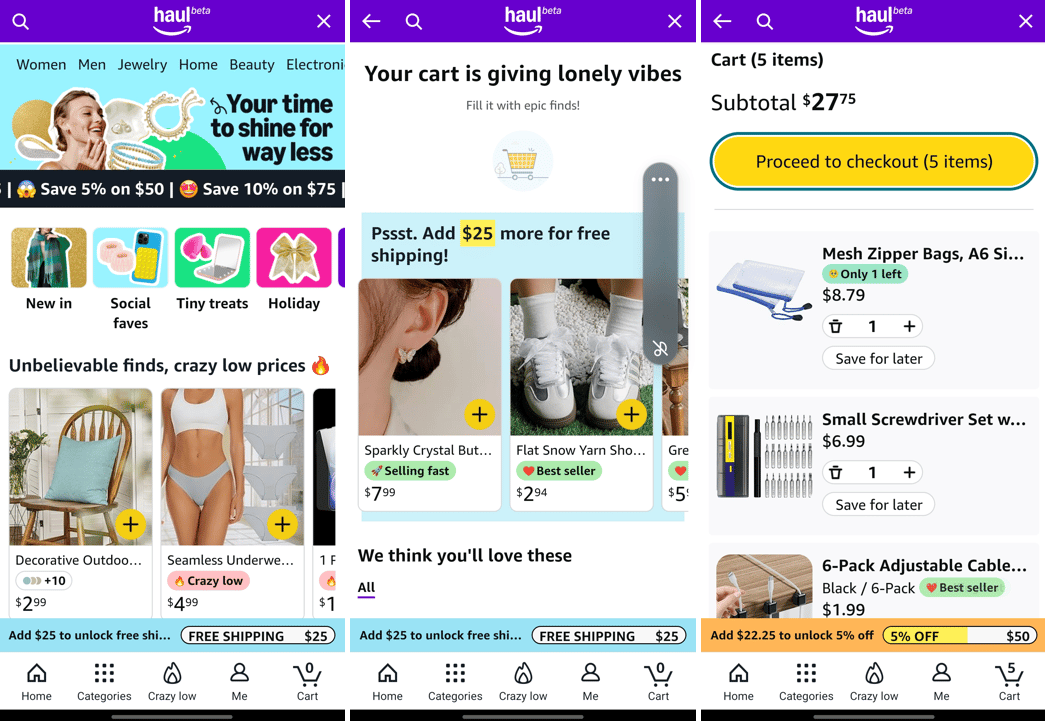
Bazaar originally launched in Mexico and has since expanded to Saudi Arabia and the UAE.
Like Temu and Shein, the focus is on ultra-affordable goods, but with Amazon’s infrastructure handling fulfillment and delivery through its partner network.
This move comes as U.S. import tariffs impact price-sensitive shoppers, driving interest in more affordable e-commerce options.
Unlike Temu and Shein, which were affected by the recent removal of duty-free exemptions, Amazon’s model relies on its global fulfillment centers to ship directly.
The company’s international revenue reached $40.9 billion last quarter, and this budget offering could help them reach even more customers, particularly in regions where price remains a key factor.
While still early days, Bazaar represents a notable step in Amazon’s broader global growth strategy, especially as it competes with Chinese rivals in the fast-growing low-cost e-commerce space.
The $100M Amazon Playbook (2025 Edition)

1. Scaling in the Wrong Sequence
Most brands fail because they scale out of order chasing random tactics instead of diagnosing their true constraint.
Sellers obsess over the newest SEO hack, then pivot to PPC, then videos burning resources on the wrong bottleneck.
You fix one at a time. Not all four at once.
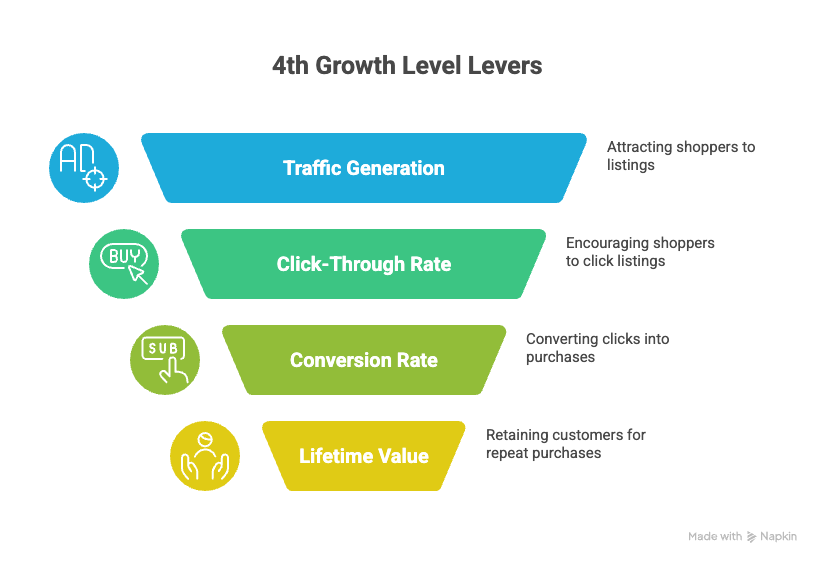
2. The Four Growth Levers
Every Amazon brand can be reverse-engineered through these four levers:
He teaches clients to zoom out and look at their brand through four key growth levers:
Traffic (Are you being seen?)
Click-Through Rate (CTR) (Are people choosing your product?)
Conversion Rate (CVR) (Are they buying?)
Lifetime Value (LTV) (Are they coming back?)
3. The Four Pillars of Scaling: The $100M Foundation
The “4x4 Framework” combines the Four Pillars (foundation) with the Four Growth Levers (execution). This is the same model they use to manage $80–100M in annual Amazon revenue.
Pillar 1: Brand Control & Equity Protection
Enforce MAP pricing across distributors.
Register and protect on every marketplace Target+, Walmart, and international Amazon stores.
Use Transparency Codes and Brand Registry to block hijackers early.
Even if Target doesn’t sell volume, claim your listings first. If someone else does, it’s a month-long fight to reclaim your brand presence.
Pillar 2: Operational Stability
If you’re out of stock, nothing else matters.
Maintain 1-day delivery coverage to all 48 U.S. states, tools like SmartScout Heatmaps can visualize shipping lag zones.
Use multi-node FBA or 3PLs to reduce inbound placement fees (which recently doubled in some zones).
Pillar 3: Strategic Alignment
Your brand needs unified strategy across every channel:
Walmart packaging = shelf appeal.
Amazon packaging = efficiency and conversion.
Pricing misalignment kills you. If Walmart’s price is lower, Amazon suppresses your Buy Box.
Pillar 4: Real-Time Growth Intelligence
Implement tactics that work today, not last year:
Intent-based SEO (use “what” and “why” keywords, not just stuffed phrases).
External traffic: TikTok → Amazon still boosts organic rank because Amazon rewards off-platform referrals.
Updated listing structures: Amazon now favors top-loaded listings (main image, title, A+), not bullets buried on mobile.
4. The Advanced Seller Mindset
Solve one bottleneck at a time.
Document every change (so you know what actually worked).
Don’t chase shiny tools until you’ve mastered fundamentals.
Know your numbers better than Amazon does.
⚒️ Step-by-Step Email Creation with AI
Level: EASY
If you’re new to AI, here is a simple walk-through on how to create an email campaign in minutes.
Remember the more information your input, the better the output.
1. Define the Campaign Goal
We started with a clear mission: drive webinar registrations. We wrote down the purpose, target audience (small business owners), and main conversion point (webinar signup).
2. Prompt AI for a Campaign Outline
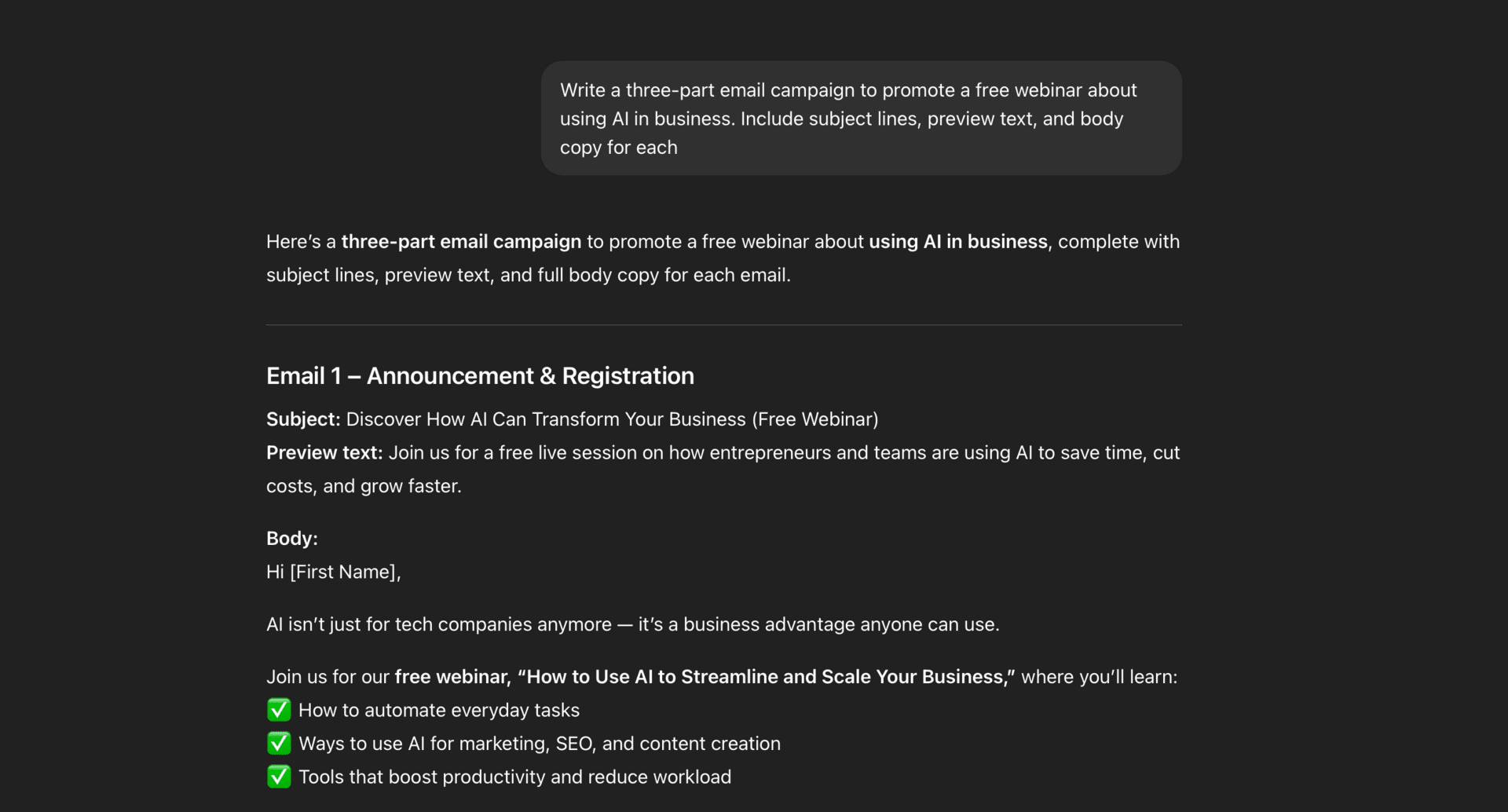
Using ChatGPT, we entered a prompt like:
‘Write a three-part email campaign to promote a free webinar about using AI in business. Include subject lines, preview text, and body copy for each.’
This gave us three complete, well-structured emails, timed for immediate send, a reminder, and a last-chance nudge.
3. Tailor Tone & Brand Voice
To match our client’s approachable style, we asked the AI to rewrite the emails in a friendly, conversational tone. For more formal audiences, you can simply request a professional rewrite.
4. Generate Subject Line Variations
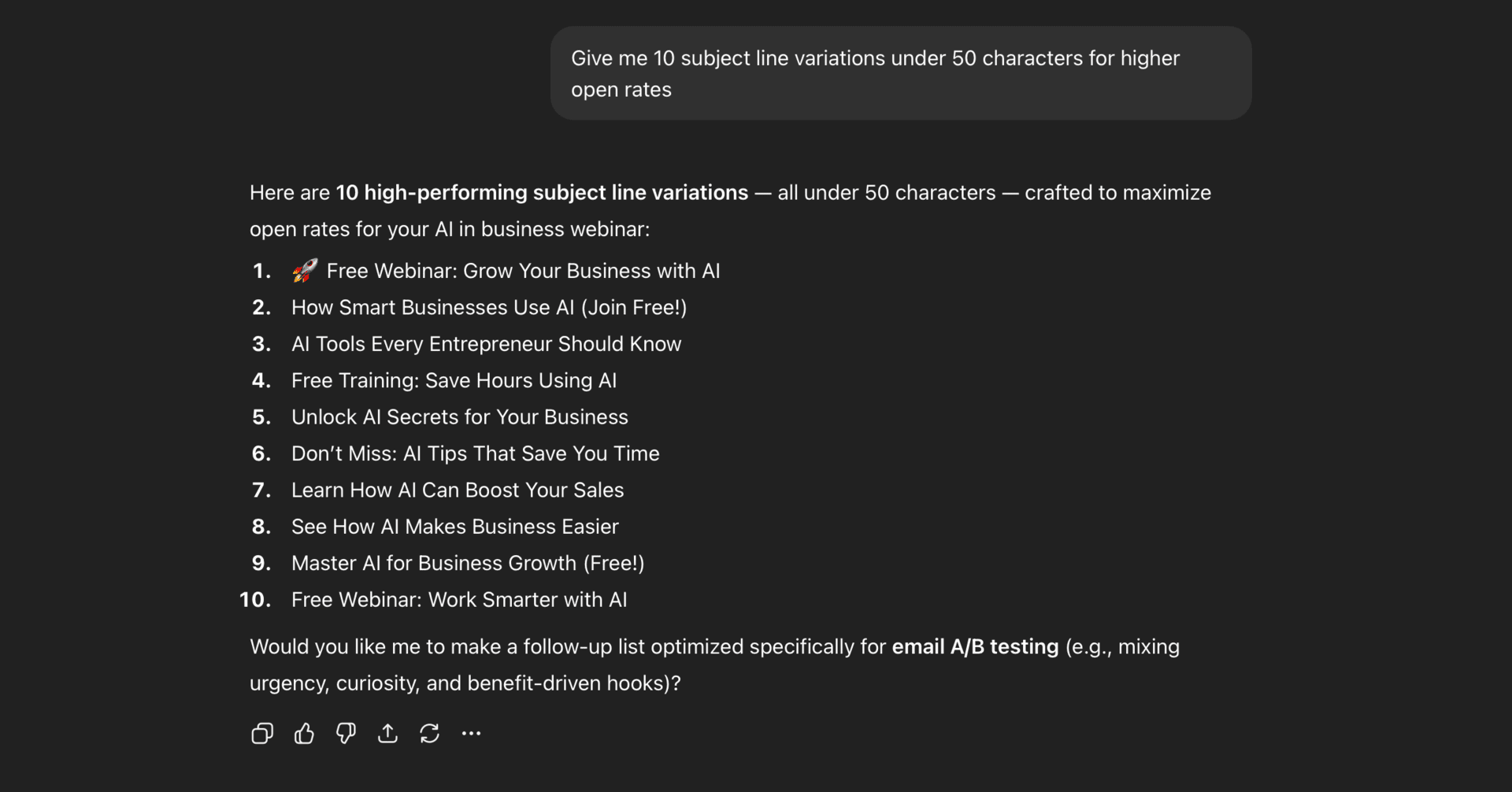
We prompted:
‘Give me 10 subject line variations under 50 characters for higher open rates.’
AI delivered a list of catchy options, making it easy to run A/B tests or pick the best fit for each segment
5. Personalize at Scale
We provided the AI with sample customer segments (e.g., “owners in retail” vs. “B2B consultants”) and asked for tailored copy. The tool swapped in relevant details and adjusted messaging automatically, letting us scale personalization without more manual work.
6. Repurpose for Social & Beyond
After the campaign, we prompted:
‘Turn these emails into LinkedIn posts and a short blog summary.’
The AI delivered ready-to-use content, extending our campaign’s reach in minutes.
If you would like to learn more about AI → FUTUREPEDIA

🔥 He Sold His 7-Figure Amazon Brand to Gamble?!

Here are my favorite tips from this episode!
1. From Top Amazon Seller to YouTube Creator
Mike built and sold multiple Amazon brands including ColorIt (adult coloring books) and IceWraps but ultimately exited in 2024 after a decade on the platform.
He saw the “writing on the wall” by 2019. By 2024, the warning became truth:
Amazon fees rose 20–30%.
Chinese sellers bypassed U.S. brands.
Tariffs and compliance red tape made operations unpredictable.
Margins fell below 5%.
2. The Funnel That Built a $7-Figure Brand
Mike’s real advantage was owning the customer.
He used free giveaways and low-friction offers to build an email list that converted long-term:
Free sample coloring pages (lead magnet).
$5 shipping-only offers → One-Click Upsells via Ezra Firestone’s app.
Klaviyo email funnels to drive repeat purchases.
Weekly Facebook Lives to build community and loyalty.
Once customers made 3+ purchases, retention skyrocketed.
3. The Pivot to YouTube
After selling his brands, Mike applied 20 years of marketing experience to a new content business:
🎰 Desert Degens, a daily YouTube channel where he and a friend film themselves gambling at Las Vegas casinos.
Why it works:
They upload one long-form video and 4–7 shorts daily.
Six months in: 10K subscribers, 700+ uploads, 45K+ views per top video.
Average viewer watch time: 18 minutes, exceptional retention.
$15 RPM → 3–4x industry average.
4. Turning Losses Into Assets
At first, every video was filmed with their own gambling money — losing most days. But YouTube ad revenue soon covered those losses:
Long-form videos → $15 per 1,000 views (high CPM for entertainment).
Shorts → low CPM, but strong for reach.
Merch → “Degenerate” shirts sold daily.
Future: Sponsorships, affiliate offers, travel partnerships, and cruises.
5. Algorithm Psychology: Consistency > Virality
Mike proved a law of YouTube most creators ignore:
Post daily for 150–180 days.
Don’t chase trends.
Keep production quality improving 1% each week.
Watch the algorithm “flip” once enough data builds.
After 6 months, every video began getting 1K+ views.
🔥 Watch the full episode here
Find this episode of Marketing Misfits on YouTube and anywhere you listen to podcasts
🌎 MARK DOWN THESE EVENTS! 🌎
Nov 10-12 - Nashville - Starting at $429
Nov 13-17 - Austin - Starting at $3997
Feb 10-12 - Dubai - Free
Mar 10-12 - Las Vegas - Starting at $99
→ FULL CALENDAR ←
And that’s it, Beardos.
See you next Monday!
- Norm

Interested in sponsoring the Lunch With Norm Newsletter? Reply back to this email for more details.
Reply